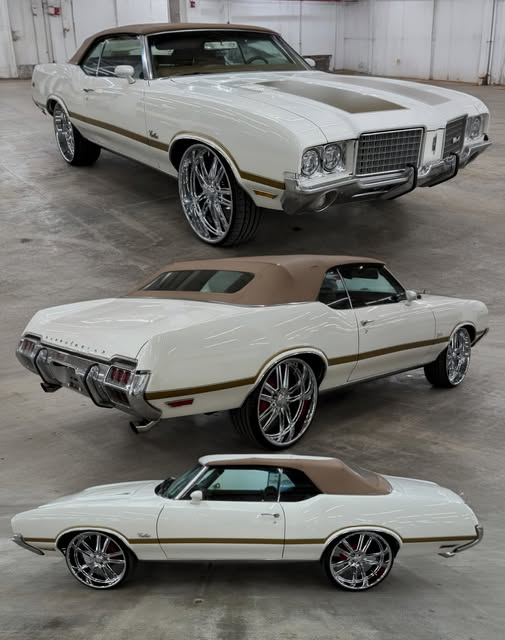
The 1972 Oldsmobile Cutlass Convertible sat quietly under the fluorescent lights of a warehouse, its pearl-white paint gleaming like new snow under a winter sunrise. Gold pinstripes traced its curves like fine jewelry, and the tan top folded neatly against its sleek frame. Its stance was bold—thanks to those massive chrome wheels that shimmered with attitude—and yet, beneath all the shine, the car held a story that stretched across generations.
It began with Earl Jennings, a young man fresh out of college in 1972, standing on the lot of Johnson Oldsmobile in Baton Rouge. He’d just landed his first teaching job and wanted something that wasn’t just transportation, but a statement. When he saw the new Cutlass convertible sitting there under the sun, top down, interior tan and perfect, it was love at first sight. The salesman didn’t need to say much—Earl was already sold.
He drove that car like it was part of him. The 350 Rocket engine purred with smooth authority, and when the top went down, every drive felt like a parade. He met Clara, his future wife, cruising through town one warm Louisiana evening. She was standing with friends outside a diner when Earl pulled up, radio playing Al Green. Clara later said it wasn’t just the car—it was the way he smiled behind that wood-grain steering wheel. But she admitted, years later, that the Cutlass helped.
They got married the next spring, drove that Olds on their honeymoon to Gulf Shores, and for a while, life was perfect. But as the years went by, jobs changed, kids came, and priorities shifted. The Cutlass, once the heart of their weekends, became a garage queen. It still got started up every now and then, still carried them to the occasional summer picnic, but it wasn’t the center of attention anymore. When Earl retired, the Oldsmobile was still there—dusty, but proud—waiting for one more chapter.
When Earl passed, his grandson Marcus inherited the car. At first, Marcus didn’t know what to do with it. He was into modern imports—turbocharged, tech-laden, built for speed, not soul. But when he rolled up that garage door and saw the Olds under the tarp, something stirred. He peeled back the cover and stared at the long hood, the broad chrome grille, the smell of old leather and oil. His grandfather’s hat was still sitting on the passenger seat. That moment changed everything.
Marcus decided to restore it—not to factory stock, but the way his generation understood style. He kept the original color scheme, but added a modern twist—26-inch chrome wheels that caught light like diamonds, low-profile tires, a tan top, and subtle gold accents that echoed its original pinstripe. Under the hood, he rebuilt the 350 with performance internals, making sure it had the same roar Earl once loved, only sharper.
When he finished, the car was a perfect blend of eras—classic soul with modern shine. The first time he took it out, he played that same Al Green song his grandfather once had. The engine hummed, the wind swept through the open top, and Marcus smiled. It felt like the old man was riding shotgun.
Everywhere he went, people stopped to look. Old-timers admired the lines. Young folks stared at the rims. But Marcus didn’t build it for show—he built it for legacy. He named it “Golden Line” in honor of the subtle gold trim and the unbroken thread between generations.
Now, every Sunday evening, he drives the Oldsmobile down the same country road where Earl once met Clara. The sun hits that white-and-gold paint just right, turning it into a moving beam of nostalgia. For Marcus, it’s more than just a car—it’s a bridge through time, a promise kept, and proof that style, love, and craftsmanship never fade.
And when the last light of the day reflects off those massive chrome wheels, the old Cutlass doesn’t look fifty years old at all. It looks eternal.