The 1969 Dodge Super Bee wasn’t born to blend in—it was built to sting.
A raw, unapologetic muscle machine that rumbled louder than the city it prowled, wearing a coat of sleek metallic silver and a soul as red as fire. This particular Super Bee had lived through decades of asphalt wars, heartbreaks, and redemption—and like every survivor, it carried its scars with pride.
Chapter 1: The Roar Begins
In the summer of 1969, when gas was cheap and horsepower ruled the streets, Jack Monroe walked into a Dodge dealership in Detroit with grease-stained hands and a grin that said he already knew what he wanted. Jack wasn’t just a mechanic—he was a dreamer. He’d spent his early twenties building engines for other men’s glory. This time, it was his turn.
There it was—sitting under the showroom lights like a coiled muscle ready to strike.
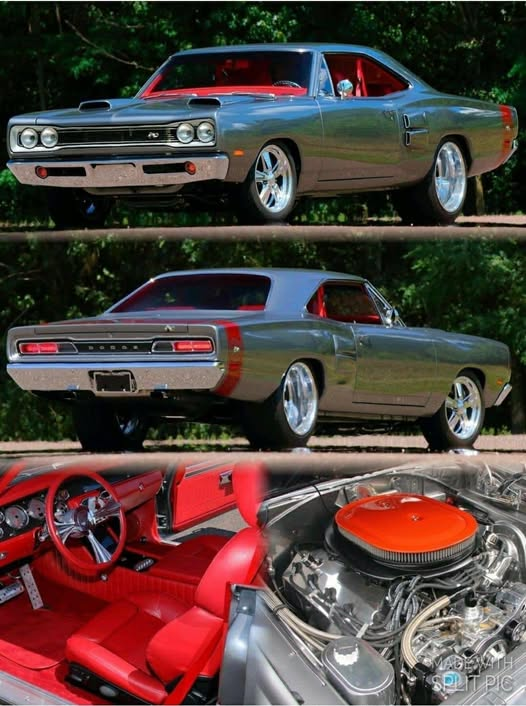
A Dodge Super Bee 440 Six Pack. Chrome trim glimmered under fluorescent bulbs, the hood scoops promised violence, and the red interior looked like something out of a racecar fantasy. The salesman started his pitch, but Jack interrupted:
“Save it, pal. I’ll take it.”
He handed over the cash he’d saved from two years of overtime at the auto plant. As he slid behind the wheel and fired it up, the 440 engine came alive with a guttural growl that shook the floor. Jack smiled. “Now that’s music.”
Chapter 2: Asphalt King
That fall, the Super Bee became a legend in Detroit’s underground street scene. Jack raced it at midnight meets under the old freeway bridge, where the air reeked of burnt rubber and adrenaline. Word spread fast—no one could touch Monroe’s Bee.
They said when its silver body streaked past under the streetlights, it looked like lightning wrapped in chrome.
They said the red interior glowed like hellfire.
And they said Jack never lost a race.
For him, it wasn’t about money or fame. It was about freedom—the feeling of the tires gripping, the tach climbing, the wind roaring through the windows. In that car, he wasn’t just alive; he was untouchable.
But every king faces a fall.
Chapter 3: The Crash
One night, a rival driver—someone with more ego than experience—challenged Jack to a run through the industrial district. No rules, no crowd, just two cars and the night.
They launched side by side, engines screaming, gear shifts echoing off warehouse walls. Jack had him—until a semi pulled out from a side road. Jack swerved, missed the trailer by inches, but slammed into a guardrail. The Bee spun, metal shrieking, smoke rising.
When the dust settled, Jack was alive—but the Super Bee wasn’t. Its nose was crumpled, frame bent, and the mighty 440 groaned its last. For months, Jack stared at the wreck in his garage, guilt and pride mixing in his veins. Eventually, life moved on. He got married, had kids, and the Bee gathered dust.
But he never sold it. He couldn’t.
Chapter 4: The Rebirth
Decades later, in 2012, Jack’s grandson Eli Monroe, a 24-year-old gearhead himself, found the car under an old tarp in the family barn. Rust had eaten the edges, paint had faded, but the badge still shone faintly: Super Bee.
“Grandpa,” Eli said, “I want to bring her back.”
Jack smiled—the same crooked grin from his racing days. “Then let’s sting again.”
Together, they stripped the car down to its bones. Every bolt, every line, every dent was reborn. Eli insisted on modern upgrades—coilover suspension, four-wheel discs, custom billet wheels—but kept the soul intact: the 440 Six Pack, the red interior, and the silver body that glimmered under the sun like mercury.
When they finally fired it up, the garage shook.
Jack’s eyes watered—not from age, but from memory.
“She sounds just like she used to,” he whispered.
Chapter 5: Full Circle
A year later, they entered the Super Bee in the Woodward Dream Cruise, Detroit’s sacred pilgrimage for classic car lovers. Crowds stopped, jaws dropped. Some older guys pointed and said, “Now that’s a real car.” Kids ran up for photos, eyes wide with wonder.
As the Bee rolled down Woodward Avenue, Eli drove, and Jack rode shotgun. The streets that once echoed with his youthful glory now echoed again—with the same growl, the same heartbeat, only this time through his grandson’s hands.
Halfway down the strip, Eli turned to him. “You ever regret crashing her?”
Jack chuckled, looking out at the rows of cheering faces. “Nah. Some legends need a fall before they rise again.”
Epilogue: Legacy of the Sting
After Jack passed away a few years later, Eli kept the Bee exactly as they rebuilt it.
He took it to car shows, races, and sometimes just out for midnight drives—like his grandfather once did. People still stop him, still ask about it, still feel the pulse of history in its sound.
And every time the engine roars to life, Eli swears he can feel his grandfather beside him—grinning, shifting gears, daring the world to keep up.
Because the ’69 Dodge Super Bee was never just a car.
It was a bond, a bloodline, and a reminder that some machines aren’t built just to run—they’re built to live forever.