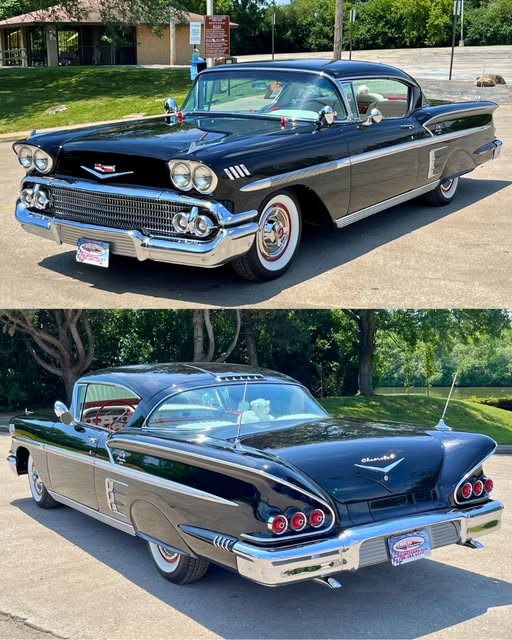
The 1958 Chevrolet Impala gleamed beneath the garage light like a black diamond — polished, proud, and timeless. Its sweeping fins, triple taillights, and long, confident stance spoke of a different world — one where jukeboxes played rock ’n’ roll, gas was cheap, and dreams fit neatly behind the wheel.
To Henry Lawson, it wasn’t just a car.
It was his story.
He bought it brand new the summer he turned twenty-one. The first of its kind — Chevrolet’s bold leap into the future. “A man’s car,” the salesman had said, “with a heart that hums and a body that turns heads.”
And he wasn’t wrong. The Impala had presence. Black exterior, red-and-cream interior, whitewall tires gleaming like pearls. When Henry pulled up to the diner that first night, heads turned — especially one.
Evelyn Pierce, the redhead who worked the counter, leaned on the window and said with a smirk, “Nice ride, mister. You sure you can handle it?”
Henry grinned. “Only one way to find out.”
That was the beginning. The Impala became their chariot — their escape from the small Texas town they called home. They drove it to the drive-in theater, to the lake where they shared their first kiss, to the church the day they married. Every milestone was marked by the hum of that 348-cubic-inch engine.
Life moved fast — just like the Impala.
Years later, when Henry returned from Vietnam, his uniform still smelled of smoke and distance. The world had changed — muscle cars ruled the roads now, the Beatles replaced Buddy Holly, and Evelyn had a small boy clinging to her leg. Their son, Michael, stared at the Impala with wide eyes, awestruck.
“That’s Daddy’s car,” Evelyn told him.
From that day on, it became their car.
The Impala saw family road trips across dusty highways, laughter in the back seat, and summer nights parked under endless skies. Michael would always beg, “Daddy, faster!” and Henry would laugh, pressing the pedal just enough to make the engine growl.
But as time rolled on, life’s priorities shifted. Gas prices rose, jobs changed, and the Impala, once Henry’s pride, became a garage queen. When Evelyn passed unexpectedly in the winter of ’89, he covered the car for good — as though hiding the past could keep the memories from hurting.
For thirty years, the Chevy sat silent.
Then came Michael, all grown up now, standing in the same garage where he’d once played with toy wrenches. His father was gone, leaving behind little more than an old photo album, a few service medals… and the keys.
He pulled the cover back slowly, the scent of age and dust filling the air. The Impala was there — tired, but still beautiful. The chrome was dull, but the soul was intact. He ran a hand across the hood, his reflection faint in the paint.
“You waited for me, didn’t you?” he whispered.
Over the next year, Michael poured his evenings into restoring her. Every bolt, every polish, every shine carried a memory of his father’s laughter and his mother’s voice singing along to the radio. Some nights, he’d fall asleep in the driver’s seat, dreaming of the open road and simpler times.
The first time the engine started again, he cried. The low rumble filled the garage, deep and familiar, like an echo of his childhood.
The following summer, Michael took the Impala out for her first drive in decades. The same roads, the same sunlit fields. He parked by the old lake — the one from his parents’ stories — and pulled a worn photo from the visor: Henry and Evelyn, young and smiling beside the car.
He smiled through tears. “She’s still running, Dad. Still shining, Mom.”
As the sun dipped low, the car gleamed like liquid glass. A faint breeze rustled through the trees, and for a moment, Michael could almost swear he heard laughter — his mother’s soft giggle, his father’s deep chuckle, carried by the wind.
He started the engine again, turned the dial on the radio, and a crackling tune filled the air — “Johnny B. Goode.”
Perfect.
The Impala rolled down the road, smooth and sure, the chrome reflecting the golden light of evening. Behind the wheel, Michael felt something deeper than nostalgia — a sense of continuity.
The car had outlasted wars, time, and loss. It had carried love, sorrow, and now, healing.
And as the headlights cut through the dark, one truth echoed in his heart:
Some engines never stop running — not really. They just wait for the right hands to turn the key again.