The year was 1957, and the city of Chicago pulsed with jazz, neon, and the scent of rain on asphalt.
Down on West Madison Street, the night belonged to Johnny Mercer — not the singer, but the man everyone called “Cadillac Johnny.”
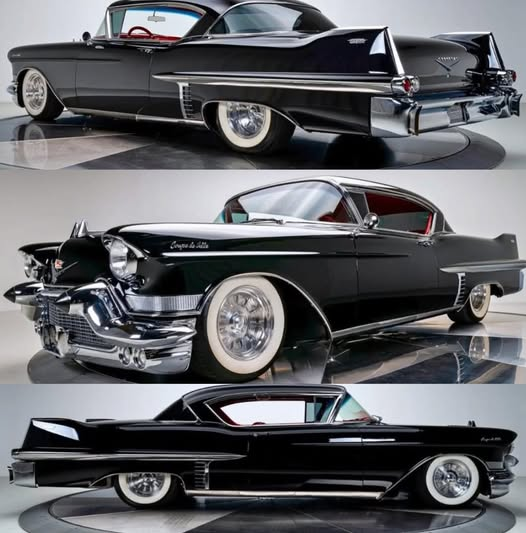
Johnny’s pride and joy sat under the flickering streetlight outside his garage: a black 1957 Cadillac Coupe DeVille, the kind of car that turned heads and stopped hearts. Its deep onyx paint gleamed like wet ink, its chrome trim sharp as a knife’s edge. Whitewall tires, red leather seats, and fins that looked like they could cut through the sky — it was the perfect blend of muscle and elegance.
He’d bought it the day he got back from the Army. Every dollar he saved from three years overseas had gone into that car. When he drove it off the lot, the salesman said, “Son, that car’s not just transportation. That’s a statement.”
And Johnny made plenty of statements since.
Every Saturday night, he’d roll down the boulevard with the radio humming Elvis and Fats Domino, one arm slung over the wheel, a cigarette glowing between his fingers. Girls would turn their heads. Men would stare in envy. That Cadillac wasn’t just a car — it was freedom, wrapped in chrome and gasoline.
But there was one person who mattered more than the crowds — Lydia, the girl with the red scarf and the voice that could melt steel. She worked at Benny’s Diner downtown, and the first time Johnny pulled up in front of her, engine rumbling low, she just smiled and said, “If that car’s half as smooth as you think you are, I might let you buy me a milkshake.”
That’s how it started — milkshakes, midnight drives, and whispered dreams under the city lights. Johnny promised her the world. “One day, baby, we’ll head west — California, sunshine, ocean breeze. Just me, you, and the Caddy.”
Lydia believed him. And for a while, the dream felt real.
Then came 1960, and everything changed.
Factories slowed. The shop Johnny worked at cut hours. Bills piled up. He tried to sell the Cadillac once — for rent money — but couldn’t do it. “That car’s part of me,” he’d told Lydia. “It’s the only thing that still feels like hope.”
She didn’t argue, but he could see the disappointment in her eyes. A year later, Lydia packed her bags and left for Los Angeles alone, chasing the dream they once shared. She sent one letter — said she was singing in a small club by the beach. Johnny never wrote back.
For decades, the Cadillac sat silent in his garage, gathering dust and memories. Time faded everything — the paint, the leather, even the ache in his heart. But not the love for that car. Every few months, he’d start it just to hear the deep rumble, like the growl of a sleeping beast refusing to die.
It was 2010 when the world changed again. Johnny, now an old man with shaky hands and silver hair, got a letter postmarked from California.
It was from Lydia’s daughter.
She wrote: “My mother passed recently. In her things, I found an old photograph of a black Cadillac and a note on the back that said, ‘Find Johnny. Tell him I made it.’”
Johnny sat for hours, staring at that letter. He went to the garage, brushed the cover off the Cadillac, and smiled softly. “She made it, huh, doll?” he whispered.
That night, he took the Coupe DeVille out for one last drive. The city had changed — glass towers where diners once stood — but as the headlights sliced through the misty streets, it felt like 1957 again. The engine purred, the wind whistled through the cracked vent window, and for a moment, he swore he could hear Lydia singing from the passenger seat.
At a red light, he looked in the rearview mirror and saw not an old man — but a young soldier again, grinning behind the wheel of his dream. The light turned green, and the Cadillac surged forward, smooth as ever.
The next morning, the neighbors found the car parked neatly in front of the house. Engine off. Johnny sitting behind the wheel, a peaceful smile on his face.
On the dashboard lay a faded red scarf — the same one Lydia used to wear — and her photo beside it.
The Cadillac gleamed in the sunrise, black and timeless, as if guarding the last dream of two souls who finally found their road again.