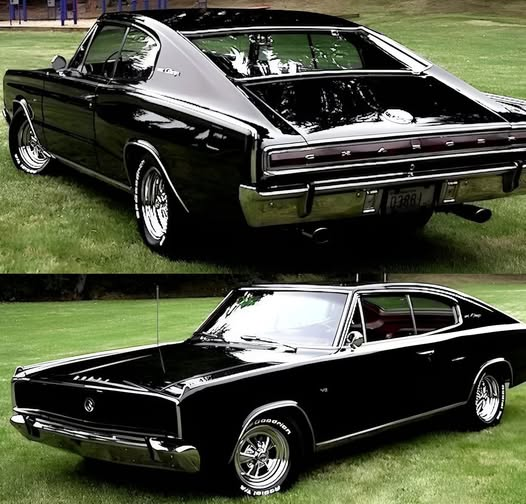
Under the soft silver glow of the moon, the 1967 Dodge Charger looked almost alive. Its black paint shimmered like midnight glass, every curve sharp and perfect, every chrome line gleaming like a blade. It wasn’t just a car—it was a story. A heartbeat on wheels. A legacy carried through time.
Eli stood in front of it, his reflection mirrored in the polished hood. His hands were rough, oil-stained, but steady. He had been working on this car for the better part of six years, restoring it bolt by bolt. To most people, it was just an old muscle car. To Eli, it was the only piece left of his father, Ray—a man who lived his life by the sound of engines and the smell of gasoline.
Ray had bought the Charger brand new in ’67, back when he was young, wild, and believed every open road led somewhere worth going. It had been his pride and joy—his freedom machine. He used to tell Eli, “A Charger ain’t just a car, son. It’s a promise. You take care of her, she’ll take care of you.”
Eli was just a kid when he’d sit in the passenger seat, feeling the vibration of the big-block V8 rumble through his chest. The way his father drove—steady, confident, smiling through the wind—it made Eli believe that car was unstoppable. But years have a way of breaking things that engines can’t fix.
When Ray got sick, the Charger sat more often than it roared. One day, when Eli was eighteen, he came home from school to find the garage door closed, the car covered in dust, and his father gone.
After the funeral, Eli couldn’t even start it. Every time he tried, his hands trembled. The sound of that engine would have been too much—too alive, too full of his father’s presence. So he locked the garage, walked away, and tried to move on.
Life took him far from home. But time has a strange way of pulling you back to where you began. When Eli returned years later, older and quieter, the Charger was still there—silent, patient, waiting. The paint was faded, the tires flat, but when he opened the door, it still smelled faintly like his father’s cologne.
That night, he made himself a promise: he’d bring her back.
The restoration wasn’t easy. There were nights of frustration, bloodied knuckles, and parts that seemed impossible to find. But every hour he spent in that garage, he felt closer to his father again. He could almost hear Ray’s voice guiding him, “Slow down, son. Let her breathe.”
And then, one cool autumn evening, after years of silence, Eli turned the key.
The Charger coughed, groaned, and then roared to life with a deep, throaty growl that shook the walls. The sound filled the air, filled Eli’s chest, filled the years between then and now. It was like his father was right there beside him again.
He eased it out of the garage, the headlights slicing through the darkness, the polished black body glowing under the moonlight. As the car rolled down the quiet country road, the night air rushed in, carrying with it the ghosts of the past and the peace of the present.
He stopped at the old diner where his dad used to take him for late-night burgers after long drives. The same neon sign buzzed above the lot, casting red and blue reflections across the Charger’s hood. Eli parked, turned off the engine, and just sat there for a while.
In the stillness, he spoke softly, “She’s running again, Dad. Just like you said she would.”
He smiled through tears he didn’t bother to wipe away. The Charger gleamed beneath the lights—strong, timeless, beautiful. It wasn’t just a car anymore. It was his father’s soul, his love, his lesson.
As Eli started the engine once more and drove into the night, the sound of that 440 echoed through the dark hills—a deep, thunderous reminder that some legacies never die. They just wait, quietly, until the right hands bring them back to life.