The ’63 Chevrolet Impala sat gleaming under the morning sun, its deep red paint glowing like hot steel fresh from the forge. Chrome trim traced its body lines with precision, and the triple taillights on each side gleamed with pride—six eyes of American power watching over the road. Under the hood, a small-block V8 pulsed with life, wrapped in chrome and red, every wire perfectly placed, every hose shining with care. It wasn’t just a car—it was a heartbeat made of metal and gasoline.
Back in 1963, Leonard “Lenny” Cortez was twenty years old and hungry for the world. He worked long hours at his father’s body shop in East Los Angeles, saving every dollar he could. He didn’t want just any car—he wanted the car. The Impala was the symbol of cool back then—sleek, confident, and unmistakable. It was the car that made people stop mid-conversation when it rolled by. When Lenny finally bought one—red on red, Super Sport trim, four-speed on the floor—he felt like he owned the streets.
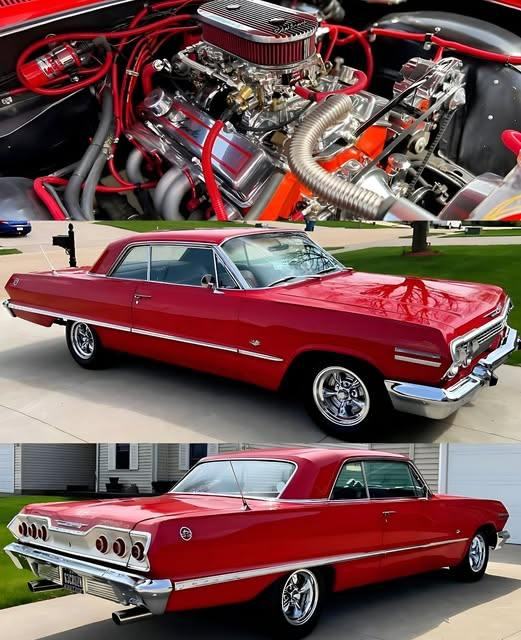
He called it “Crimson Soul.”
From that day forward, the Impala wasn’t just his car—it was part of his identity. Friday nights, he’d cruise Whittier Boulevard, the air thick with the sound of rumbling V8s and laughter. His friends followed in their own Chevys, each one customized just a little different—different wheels, different stripes, but all sharing the same energy. The boulevard was their runway, and the Impala was Lenny’s crown jewel.
That summer, he met Maria. She worked at a diner off Soto Street, always with a flower in her hair and a smile that could stop traffic faster than any red light. The first night he pulled up in the Impala, she leaned out the window and said, “That’s the cleanest Chevy I’ve ever seen.” He smiled, revved the engine, and replied, “Hop in. I’ll show you how she sings.”
From that night on, Maria rode shotgun everywhere. The Impala carried their love story—long drives to the beach, late-night talks parked on the overlook, promises whispered over the hum of the engine. The car became their escape from the world—a little red bubble where time didn’t matter and dreams felt real.
But life doesn’t stay parked in one place. Lenny got drafted in 1968, sent overseas. Before leaving, he parked the Impala in his parents’ garage, covered her up, and left Maria with a kiss and a promise: “When I come back, we’ll drive to the coast—just us and Crimson Soul.”
He did come back, but not the same. The war changed him. The Impala stayed covered for years, untouched, like a piece of frozen time. Lenny married Maria, raised two kids, opened his own small shop, and worked his whole life fixing other people’s cars. But every now and then, he’d walk into that garage, pull the tarp back just enough to see the red paint, and remember who he used to be.
When Lenny passed away, his son Gabriel inherited the house—and the Impala. The first time Gabriel saw it, he felt something familiar, even though he’d never driven it. The smell of the interior, the worn steering wheel, the faint hint of old gasoline—it was his father’s story preserved in steel. He decided to bring it back to life.
It took two years of weekends, a lot of grease, and a little help from his dad’s old friends. They rebuilt the engine, restored the paint, polished every inch of chrome until it shone like new. The first time the V8 fired up again, the garage filled with that deep, throaty rumble that once ruled the streets of East L.A. Gabriel sat in the driver’s seat, hands trembling, and whispered, “Welcome back, Crimson Soul.”
Now, on warm evenings, Gabriel drives the Impala down those same boulevards his father once cruised. He keeps the radio tuned to oldies, lets the engine hum its familiar rhythm, and sometimes, he swears he can feel his father’s spirit riding beside him—one hand out the window, smiling as the red Impala glides through the night.
And as the streetlights reflect off the polished paint, Crimson Soul isn’t just a car anymore—it’s a time machine, a legacy, a reminder that even when generations change, passion doesn’t fade. The same heart that beat in 1963 still beats today, one rumble at a time.
Because some cars don’t just drive through history—they carry it.