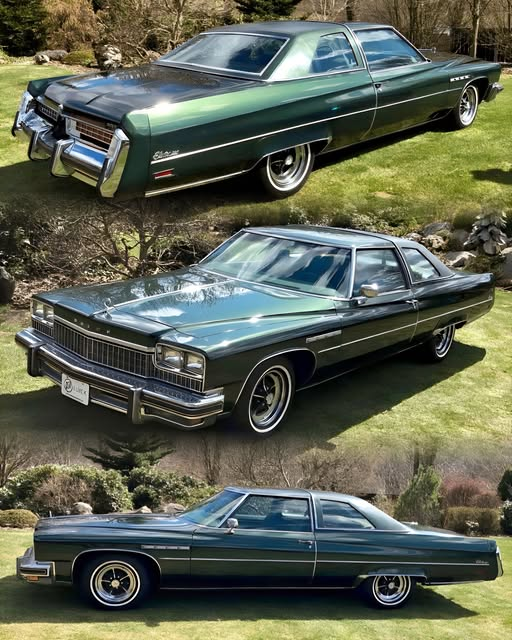
There are cars that command attention the moment they appear—and then there are cars that own the road without even trying. The 1975 Buick Electra 225 Landau was one of those machines. Deep emerald green with a black vinyl top, chrome accents wide as a smile, and a body that stretched out like it had all the time in the world. It wasn’t built for racing—it was built for presence. And for one man, it became more than a car; it became a symbol of dignity, patience, and pride.
Back in 1975, Henry “Big Hank” Wallace was a tall, soft-spoken man from Georgia with calloused hands and a quiet ambition. He worked long days at the local steel mill and long nights fixing up engines in his garage for extra cash. He’d always said, “One day, I’m gonna get me a car that rides like a dream and looks like success.”
That dream came true the day he saw the Buick Electra 225 Landau sitting under the showroom lights. The metallic green paint shimmered like money, and the salesman said it came with “Buick’s smoothest ride ever.” Hank ran his hand along the chrome trim, felt the heft of the door, and nodded. “This ain’t just a car,” he said. “This is a statement.”
From the moment he drove it off the lot, the Electra—nicknamed “Emerald Grace” by his wife, Clara—became a part of his life. Every Sunday morning, Hank and Clara would cruise into town dressed sharp, the Buick gliding down Main Street like royalty. The engine was a whisper of power, the ride softer than air, and when the sun hit that green paint, it looked like liquid glass. Kids on bicycles would stop and stare. Men tipped their hats. Women smiled. The Electra didn’t just move; it floated.
Hank treated that car like family. No one else was allowed to drive it, not even his brother. He waxed it every Saturday, covered it every night, and wouldn’t park it under trees no matter how hot the day got. The glove box held a picture of Clara and a pack of spearmint gum. The trunk—immaculate, lined with a blanket—was reserved for Sunday picnics and church trips.
Through the years, the Electra saw it all—their children growing up, graduations, weddings, and long drives through the Georgia countryside where Hank would hum along with the radio and Clara would rest her head on his shoulder. But time, as it does, kept rolling. The steel mill shut down. The kids moved away. And when Clara passed, Hank couldn’t bring himself to drive the Buick anymore. It sat in the garage, covered, silent—its once-shining chrome now dulled by dust.
By the time Hank passed, the car had been sitting for almost twenty years. When his grandson Darius came to settle the estate, he found it there—still standing proud, green paint faded but intact, like it had been waiting for him. Darius was a city boy, living in Atlanta, more used to trains and traffic lights than V8 engines and whitewall tires. But when he pulled the tarp off that Buick and the sunlight hit the body, something clicked deep inside.
He decided to bring Emerald Grace back.
It took months of weekends, research, and a few lessons from old-timers who remembered how Buicks were meant to feel. He replaced the belts, buffed the chrome, had the 455 engine rebuilt until it purred like new. He restored the black Landau top, repainted the body in its original emerald green, and polished every inch until it shone like it did in 1975.
The day it rolled out of the garage, Darius felt something spiritual. He slid behind the wheel, adjusted the rearview mirror, and saw himself—and maybe a bit of his grandfather—looking back. The smell of leather and oil filled the air. When he turned the key, the Electra came alive with a deep, confident hum that filled the quiet neighborhood.
He took it for a long drive down the same country roads Hank once traveled. The car glided just as smooth, the wind rolled in soft through the half-open window, and the sun gleamed off the chrome trim like gold. Somewhere between the hum of the engine and the rhythm of the tires, Darius felt peace.
Now, every spring, he takes Emerald Grace to local car shows. People gather around, admiring the paint, the size, the elegance. Some older men smile knowingly and say, “That right there—that’s a real car.” Darius just nods. He doesn’t brag. He doesn’t need to. The car speaks for itself.
Sometimes, late at night, he parks it in his driveway and sits inside with the engine off, just listening to the quiet. He swears he can still smell his grandfather’s cologne faintly in the upholstery and hear his grandmother humming along to old soul music.
For Darius, the Electra isn’t just a memory. It’s a bridge—between generations, between dreams, between the past and the present. It’s proof that some things built with pride and love can outlast time itself.
And when the light hits that emerald paint just right, it gleams like it always did—an unbroken reflection of grace, strength, and legacy on four wheels.