There are cars that people drive, and there are cars that people remember.
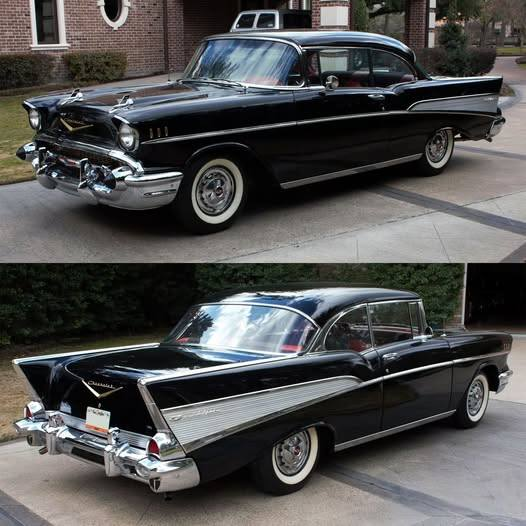
The 1957 Chevrolet Bel Air Hardtop—sleek, black, and wrapped in chrome—was one of the latter. It didn’t just turn heads; it defined an era. Its tailfins sliced through time like wings, and its golden emblems glimmered with pride. But this Bel Air, known by those who loved it as “Black Diamond,” carried more than shine—it carried stories, secrets, and the echo of a time when the open road was a symbol of the American dream.
Chapter 1: A Dream on Four Wheels
In 1957, William “Bill” Turner, a World War II veteran turned small-town teacher, walked into Henderson Chevrolet with a sense of victory. Life had finally steadied after years of chaos. He’d married his high school sweetheart, Margaret, bought a modest house in Illinois, and was about to become a father.
And then he saw her—gleaming under showroom lights, all jet-black curves and chrome edges. The salesman called her the “Bel Air Hardtop—Chevy’s crown jewel.”
Bill didn’t care about marketing. What he saw was perfection: the proud gold “V” emblem, the rocket-like tailfins, the promise of power under the hood.
He told the salesman, “Wrap her up. She’s coming home.”
That car became his pride and joy, his sanctuary from the world. On weekends, he’d polish it until the reflection of the sky looked sharper than glass. Neighbors would gather, admiring the lines, the shine, the spirit of something new and unstoppable.
Margaret would laugh and say, “Bill, you love that car more than me.”
He’d wink back. “Only until the gas runs out, honey.”
Chapter 2: Miles of Memories
Through the late ‘50s and ‘60s, the Bel Air carried the Turner family through life’s every milestone. It was the car that brought their newborn daughter Susan home from the hospital, the car that took them to church every Sunday, and the one parked proudly in front of the house during neighborhood block parties.
Bill drove “Black Diamond” everywhere—long summer drives with the windows down, music from The Everly Brothers crackling through the radio. He’d rest one hand on the wheel, the other out the window, the rhythm of the road matching the rhythm of his heart.
To Susan, that car wasn’t just transportation—it was magic. She’d sit in the back seat, legs too short to reach the floor, watching the world blur past in a kaleidoscope of color and chrome.
But as years passed and newer cars appeared—Mustangs, GTOs, and Thunderbirds—the Bel Air started to seem old-fashioned. Bill held onto it anyway. “They don’t make ‘em like this anymore,” he’d say, wiping a smudge from the fender. And he was right.
Chapter 3: The Silence
By the late 1970s, Bill’s health began to fade.
The Bel Air, once the pride of the driveway, sat under a tarp in the garage, its tires slowly sinking into the cement. Dust gathered on the hood like years collecting on memories.
When Bill passed in 1982, Susan—now grown with kids of her own—couldn’t bring herself to sell it. “It’s Dad’s heart,” she told her husband. “It stays.”
So, there it sat, decade after decade, a silent monument to a man and a time long gone. The chrome dulled. The seats cracked. But even in neglect, the Bel Air’s soul endured.
Chapter 4: Rediscovery
Fast-forward to 2010. Susan’s son, Jason, was cleaning out his grandmother’s old house when he found the car. The tarp fell away like a curtain on a forgotten stage, revealing the Bel Air in all its faded glory.
Jason had grown up hearing stories about “Grandpa Bill’s Chevy,” but seeing it in person hit differently. The smell of leather and old gasoline filled the air. He ran his fingers over the hood, tracing the curves. “You’re still beautiful,” he whispered.
Jason was a mechanic by trade, and right then, he made a promise—to bring Black Diamond back to life.
The restoration took two years. Every nut, bolt, and badge was meticulously polished, every panel aligned to perfection. The 283 V8 was rebuilt to sing again, the chrome trim shined like sunlight on glass, and the two-tone red-and-black interior looked showroom new.
The day he turned the key, the Bel Air came to life with a deep, throaty growl. Jason grinned. “Welcome back.”
Chapter 5: The Road Lives Again
When the car was finished, Jason took his mother, Susan, for a drive. She hadn’t sat in that seat since she was a teenager. The moment the car rolled onto the open road, tears welled in her eyes.
“It sounds just like it used to,” she said softly.
Jason smiled. “Grandpa would’ve wanted this.”
As they cruised through the old streets, the Bel Air caught reflections of the past in every shop window. People stopped and stared. Some pointed, some smiled knowingly. Jason could almost feel his grandfather’s spirit riding shotgun, hand out the window, humming to the rhythm of the road.
That night, when they pulled back into the driveway, Susan looked at her son. “Promise me you’ll never sell her.”
“I won’t,” Jason said. “She’s family.”
Epilogue: The Diamond Endures
Today, Black Diamond still gleams as if untouched by time. She appears at classic car shows, where younger generations ask questions, wide-eyed at the fins and chrome. Jason tells her story—the story of a veteran, a dream, and a car that carried love across generations.
And sometimes, when the sun sets just right, the black paint glows like glass, the golden “Chevrolet” script shines like starlight, and it feels as though Bill himself is there—hand on the wheel, smile on his face, whispering to the wind:
“Some things never fade. They just keep rolling.”